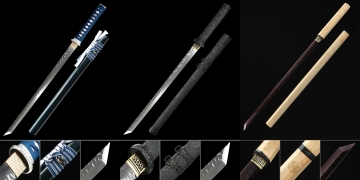
What makes Damascus steel visually distinct on a tanto blade?
Damascus steel is produced by forge-welding alternating layers of high-carbon and low-carbon steel, then folding and drawing out the billet repeatedly. This process creates a flowing grain pattern across the blade surface - often described as woodgrain, ladder, or raindrop depending on the manipulation technique used. When the blade is etched with acid during finishing, the differing carbon concentrations react at different rates, revealing the pattern in high contrast. Because each billet is worked by hand, no two Damascus tantos carry an identical surface pattern. On a tanto specifically, the shorter blade length means the full design is immediately visible without the eye having to travel far - making the patterning feel especially concentrated and dramatic.
How does a tanto differ from other short Japanese blades?
The tanto is a single- or double-edged Japanese short blade traditionally ranging from roughly 15 cm to 30 cm in length. What separates it from a ko-wakizashi or other compact forms is its construction philosophy: the tanto was designed with a relatively thick spine and minimal curvature (many are nearly straight), prioritizing rigidity in the blade geometry. The aikuchi mounting style - where no tsuba is present - is unique to tanto-length pieces and reflects a specific period aesthetic associated with court and civilian carry. In a collectible context, the tanto's compact dimensions make it highly displayable, and the decorative fittings (tsuba, menuki, kashira) are often more intricate per square inch than those found on longer swords.
What do the brown fittings and hardware actually consist of?
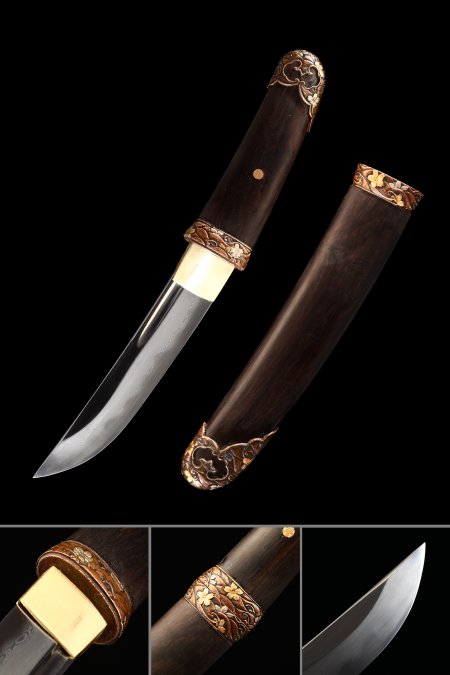
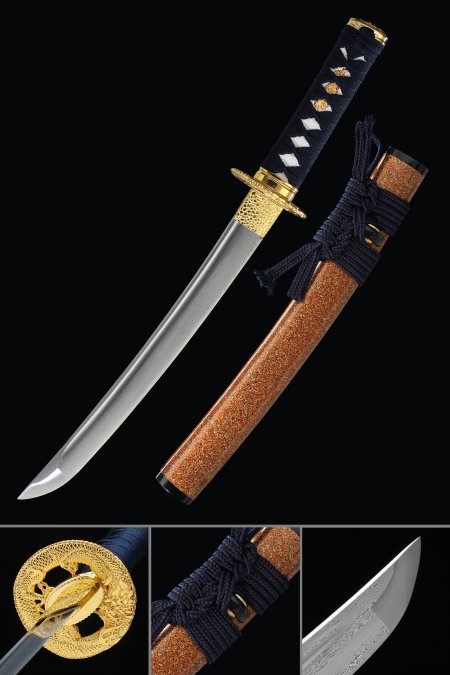
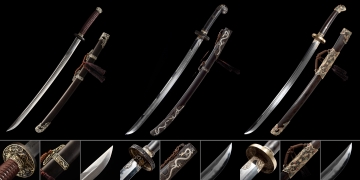
Across the Brown Damascus Steel Tanto collection, 'brown' encompasses a thoughtfully selected range of materials rather than a single finish. Dark hardwood saya (scabbards) are lacquered or oil-finished to bring out natural grain. Brown ito (handle wrap) is typically made from cotton or synthetic silk cord in an earth tone, wrapped in a traditional diamond pattern over the same-kawa (ray skin) beneath. Copper fittings - habaki, seppa, and decorative menuki - develop a warm reddish-brown patina naturally over time. Tsuba (hand guards) in gold-toned alloys contrast against darker elements while staying within the warm palette. Together these components are selected to complement the natural warmth already present in the etched Damascus grain.
How should I store and maintain a Damascus tanto long-term?
Damascus steel requires more attentive care than monosteel blades because the acid-etched surface is more porous and susceptible to oxidation if left unprotected. Apply a thin coat of choji oil or food-grade mineral oil to the blade every two to three months, wiping away any excess with a clean cotton cloth. In coastal or high-humidity environments, increase this frequency. Store the tanto in its saya with the edge facing upward in a horizontal rack, or vertically in a sword stand. Avoid sealed plastic cases, which can trap moisture. The saya interior should be checked periodically - if any debris or moisture has entered, remove the blade and allow both to dry completely before resheathing. The brown lacquer on hardwood scabbards benefits from occasional light conditioning with a furniture wax to prevent cracking.
Is a Brown Damascus Steel Tanto a good gift for a collector?
A tanto is one of the most practical gift formats within Japanese blade collecting precisely because of its size. It ships and stores easily, requires less dedicated display space than a katana, and its decorative fittings are typically more elaborate relative to its blade length - meaning there is more visual craft to appreciate up close. The brown Damascus combination in particular suits collectors who appreciate warm, natural aesthetics over high-polish modern finishes. For someone new to Japanese blade collecting, a tanto makes an approachable entry point. For an established collector, a Damascus tanto with distinctive fittings - such as a floral copper aikuchi mounting or an orange rayskin saya with crane tsuba - adds a specialized piece that stands apart from the more common katana-centric displays.